October 5, 2026
Expanding a franchise network is an exciting stage for any growing brand. But before you start selling new territories, there is an important question to answer: where should each franchise territory begin and end?
Getting this right is about much more than drawing lines on a map. Effective franchise territory planning combines customer behaviour, demographic data, competition, geography and commercial modelling to create territories that give franchisees a realistic opportunity to succeed.
For growing brands, getting the territory structure right early can also prevent problems later. Poorly designed territories can lead to overlap, disputes between franchisees, unbalanced opportunities and areas that are difficult to sell.
So, how do you approach franchise territory planning? Here is a practical step-by-step guide.
1. Start with how your customers actually behave
The first step is to understand your customers rather than starting with a map.
Different franchise models have very different customer behaviours. A children's activity franchise might rely on customers living within a relatively small local catchment, while a professional services business could serve customers across a much wider area.
For mobile businesses, travel time can be particularly important. A home services franchise may need to consider how many jobs a franchisee can realistically reach within a particular drive time, rather than simply assigning a fixed radius around a location.
Think about questions such as:
- How far will customers travel?
- Where are your existing customers located?
- How frequently do they use your service?
- Are customers concentrated in particular types of households or locations?
- Are there geographical features that influence travel?
- How does demand change between urban and rural areas?
Understanding these behaviours gives you a much stronger starting point for territory design.
2. Define what makes a territory commercially viable
A territory can look perfectly reasonable on a map and still be a poor commercial opportunity.
Before creating your boundaries, establish what a franchisee needs from their territory to build a sustainable business. This could include the number of potential customers, expected demand, average customer value, population characteristics or the number of businesses within the area.
This is where demographic and business data becomes particularly useful.
You might analyse population, household numbers, affluence, age, housing types, business density and other relevant characteristics to identify areas that match your ideal customer profile.
The important point is to work backwards from the franchise model. Rather than deciding that every franchisee should have an area of a particular size, establish what the business needs and then identify the geography that can support it.
At Atlas Mapping, our Vision mapping software allows businesses to explore detailed population, household, affluence and business data alongside their territories. This makes it easier to understand the opportunity behind the boundary, rather than simply looking at the boundary itself.
Explore Atlas Mapping and Vision
3. Choose the right territory structure
There is no single approach that works for every franchise.
Some brands use Postal boundaries because they are relatively easy to understand, communicate and include within franchise agreements. Others may use drive-time territories, particularly where franchisees travel directly to customers.
Geographical boundaries can also be useful. Roads, rivers, railway lines and other natural or recognisable features can sometimes create practical boundaries that make sense to franchisees and customers.
The best approach may also combine several methods. For example, Postal boundaries could form the initial framework, with demographic analysis and drive-time modelling used to check whether the territories are commercially balanced.
The important thing is not to choose a territory structure simply because it is familiar. It should reflect how your franchise actually operates.
4. Map your competition and existing network
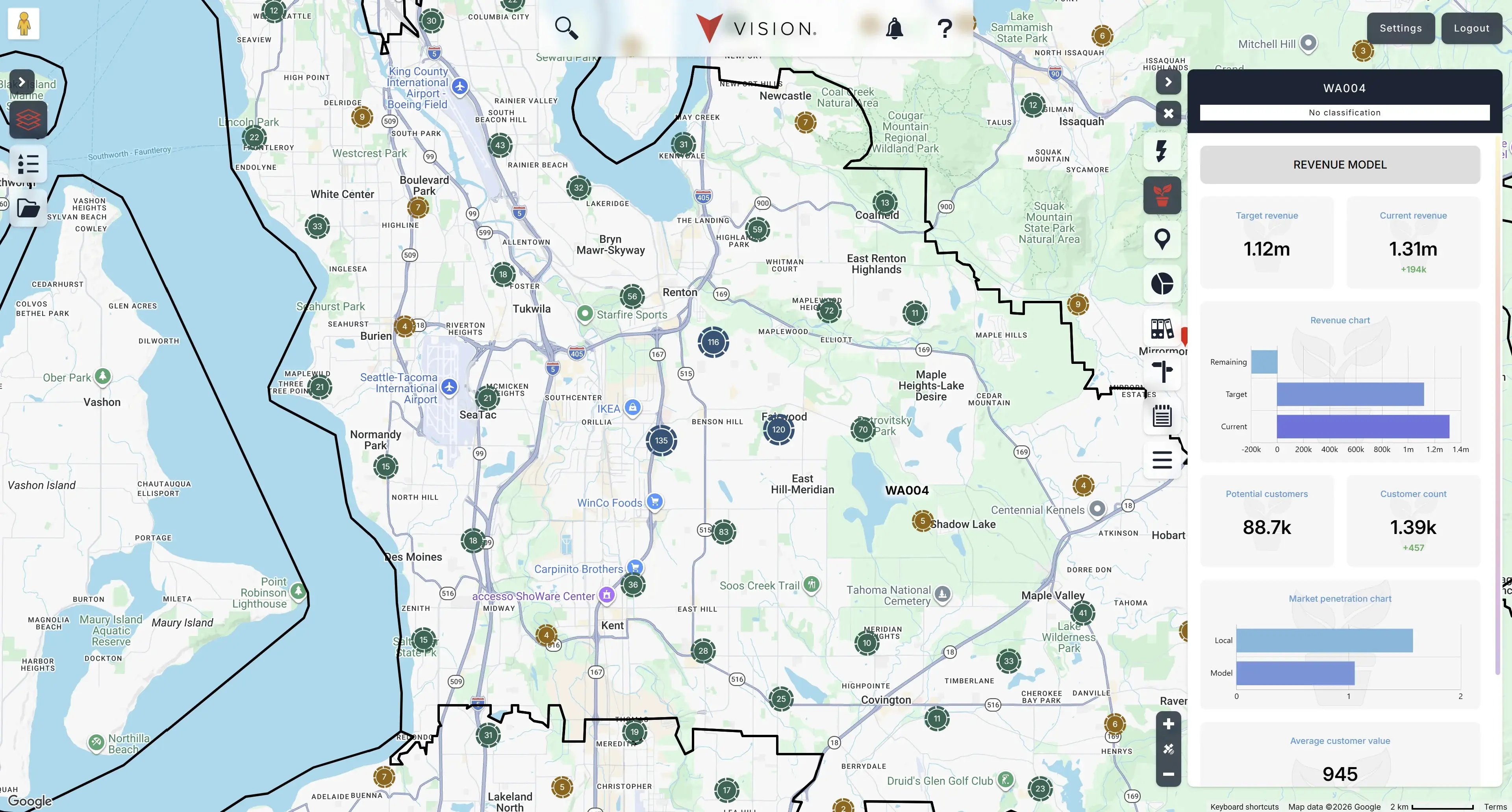
Franchise territory planning should consider more than your own franchise locations.
Mapping existing franchisees alongside competitors can highlight areas where the market is already well served and identify potential gaps in coverage.
This can be particularly useful when deciding where to recruit your next franchisee. An area with a large target market but little direct competition could represent a strong expansion opportunity. Equally, a territory that appears attractive based on population alone may be less viable if customers already have plenty of alternatives.
Your existing network should also be considered carefully. New territories should complement the territories you already have rather than creating unnecessary overlap or internal competition.
With mapping software, you can bring these different layers together and assess the wider market in one place.
5. Build the bigger picture before selling territories
One of the easiest mistakes to make is designing territories one at a time.
You might have a strong franchise prospect in a great area, so you create a territory around them. A few months later, another prospect comes along nearby and suddenly you are trying to work out how the remaining area should be divided.
This reactive approach can create awkward territory shapes and make future expansion more difficult.
Instead, build a national or regional territory plan before committing to too many individual territories. This gives you a clearer view of how your network could develop over time.
It also allows you to identify areas that may need different approaches. Urban locations might support several smaller territories, while rural areas may require larger territories because customers are more spread out.
6. Test and refine your territories
Your first territory plan should not necessarily be your final one.
Once the initial territories have been created, review them against your data and your commercial assumptions. Are some territories significantly stronger than others? Are there areas with too few potential customers? Are some territories impractical from a travel perspective?
This is where visual mapping can be particularly valuable. It allows you to see how different datasets interact and make adjustments before territories are formally allocated.
It is also worth getting feedback from existing franchisees. They can provide practical insight into customer behaviour, travel patterns and local market conditions that may not be obvious from datasets alone.
Good territory planning is an ongoing process. As your network grows and your customer data develops, your understanding of the market should improve too.
7. Keep your territories clear and easy to manage
Once your territories have been agreed, they need to be clearly documented.
Franchisees should understand exactly where their territory starts and ends, what protection they have and how neighbouring territories are handled. Clear maps and territory schedules can help remove ambiguity and make the network easier to manage.
It is also worth considering how your territory plan will be maintained as the business grows. A spreadsheet and static map may work for a small network, but managing hundreds of territories manually can quickly become difficult.
This is where dedicated territory mapping software can make a difference. Atlas Mapping's Vision platform is designed to help businesses create territories, plot customers and locations, analyse drive zones and understand potential revenue. Atlas Mapping also provides specialist territory mapping services for more complex projects, taking on the analysis and mapping work for businesses that need additional support.
See Atlas Mapping's territory mapping services
Franchise Territory Planning Should Support Growth
Good franchise territory planning is ultimately about creating a network that works for both the franchisor and the franchisee.
The strongest territory models are based on evidence. They consider customer behaviour, market potential, competition, geography and the commercial requirements of the franchise. They are also flexible enough to evolve as the network grows.
Most importantly, a territory should not just look good on a map. It should represent a realistic opportunity for a franchisee to build a successful business.
By combining accurate data with practical mapping and a clear understanding of how your franchise operates, you can create a territory structure that supports expansion rather than creating problems further down the line.
Whether you are preparing to franchise your business, reviewing an existing network or planning your next stage of expansion, Atlas Mapping can help you turn complex market data into clear, practical territory decisions. Contact us today to find out more, or sign up for a free Vision account to see how our mapping software can help your brand grow.


.svg)