December 9, 2025
Choosing the right location for a business isn’t just about finding somewhere “nice” or “cheaper”. It’s a nuanced decision that is a blend of strategy, data, and a little bit of intuition. Your location can shape everything from who your customers are, to how easily you reach them, to how seamless your operations become. At Atlas Mapping, we think of location not as a backdrop for your business but as a foundation. And when picked well, it sets you up for long-term success.
If you’re asking yourself, “where should we open our next shop/branch/office?” here are the main factors to consider and why they matter more than you might think.
Customer Proximity & Market Demand
One of the first questions we ask when helping clients with location strategy is: where are your customers? Are they clustered in a particular city, spread across suburbs, or evenly distributed nationwide?
If your business depends heavily on walk-in customers (e.g. retail, services), being close to a densely populated area or near your target demographic matters. However, if your customers are widely spread, you might prioritise ease of access, such as the proximity to main roads, transport hubs or good coverage across regions. On top of this, it is also about understanding the local demand in each area and if there are underserved pockets where a business like yours could flourish.
The right location means aligning with where your customers are and not trying to drag them somewhere far out of their way.
Accessibility and Transport Links
A location might look great on paper but if it’s a nightmare to reach, that could seriously undermine your chances. Accessibility is critical.
In terms of transport infrastructure, good road links and public transport options make all the difference not just for customers but also for staff and suppliers. The convenience of being able to commute to a location can have a large impact on employees, being more inclined to join and stay within the business if they have a reliable commute. As well as this being able to reach can influence talent attractions and also retention.In addition to this ease of access for logistics makes everything a lot more straightforward and more cost effective if your business involves supplies, deliveries or frequent stock movement.
Overall, accessibility doesn’t just affect convenience. It reduces friction and friction can erode both customer experience and internal efficiency over time.
Economic & Demographic Profile
It’s not enough to look at population density alone; you also need to understand the socio-economic and demographic makeup of a location.
- Income levels, spending habits, and age distribution: These influence whether people in that area are likely to buy what you’re offering. A shop targeting high-end customers probably won’t do well in neighbourhoods with low disposable income.
- Local competition and saturation: If there are already multiple similar businesses in a small area, you may struggle to stand out or capture enough market share. On the other hand, being the only relevant offering could be a strong advantage.
- Growth potential: Are people moving into the area? Are there signs of emerging demand? A location may not be booming now, but if demographic trends point upward, there may be long-term upside.
In essence, think of demographic and economic data as the “terrain map” for your business. If you get it right, you can align your offering with real people and real demand.
Cost & Overheads
There’s no escaping it: cost plays a big role in where you choose to locate your business. But it’s not just about cheap rent.
Rent or purchase costs can vary by location. Prime locations such as city centres or busy high streets may attract higher rents however that does come with visibility and footfall. On the other hand suburban or rural areas might cost less but may offer fewer customers. Operational costs, including utilities, local taxes, insurance and maintenance, can all vary widely depending on the location. Areas that may seem cheap in terms of rent may end up costing more in logistics and overheads.
In some areas, labour can outstrips supply; you might face higher wages or challenges hiring. But in other places you may benefit from a ready workforce at competitive rates.
This is where a balanced approach matters: a lower-cost location can make sense but only if it doesn’t compromise on access, demand, or the long-term growth potential of your business.
Strategic Fit with Business Model & Brand Positioning
Your chosen location must align with your brand’s identity and business model. What works for one type of business may be wrong for another.
For example, a luxury brand may need a high-end retail spot, perhaps in a city centre or affluent neighbourhood, which will then match clientele expectations. However, a service based business such as home care and mobile services for example, might prioritise having a broad geographical reach, low overheads and easy logistics over higher visibility.
Many businesses we work with here at Atlas Mapping are franchises that need to take a consistent and scalable approach, where location decisions are based on data driven patterns rather than guesswork.
At the end of the day, choosing a location is a strategic act. It’s not only about where you are but how that location resonates with what your business stands for.
Data-Driven Decision-Making & Market Intelligence
A big advantage in modern business is that you don’t have to guess anymore. With data, mapping tools and market insights, you can make confident and informed decisions that will help your business grow.
This is where Atlas Mapping shines. We combine your internal business data with third-party information to help you analyse potential locations by looking at customer distribution, demographic breakdowns, transport access, competitive presence and more. For many businesses, this removes uncertainty. Instead of “gut feeling,” you operate from evidence. With the right data and analysis, what once looked like a gamble becomes a calculated move.
Long-Term Vision: Scalability, Flexibility and Future-Proofing
When you pick a location, think not only about your needs today but also your ambitions for the future.
- Scalability: Can the location support growth? If you expect to expand staff, customer base or operations, will the infrastructure and local demand hold up?
- Flexibility: Things change, consumer habits shift, logistics get reworked, neighbourhoods evolve. A good location strategy takes this into account, allowing for adaptability.
- Resilience: Economic cycles, local planning changes, transport developments can all affect how good a location is over time. A data-led approach helps you anticipate such changes and safeguard your business.
With a robust location strategy, your business isn’t just placed, it’s positioned for longevity.
Why Many Businesses Get It Wrong
Despite how obvious some of these factors seem, many businesses still choose poorly. Often it’s because they rely on their gut instinct or anecdotal evidence rather than data, and they also underestimate hidden costs like transport, staff travel time or the local competition. Another key point that is usually missed includes long-term changes building a strategy around a location that looks good at the minute may not be the same later down the line and will need to be re-assessed.
A lot of businesses notice that they tend to pick somewhere which is convenient or cheap, however, this is not where their customers truly are so they do not see the growth they were expecting. That’s why leveraging mapping and analytic tools makes a difference, as it turns site selection from a “hunch” into a strategic asset.
How Atlas Mapping Helps You Get It Right
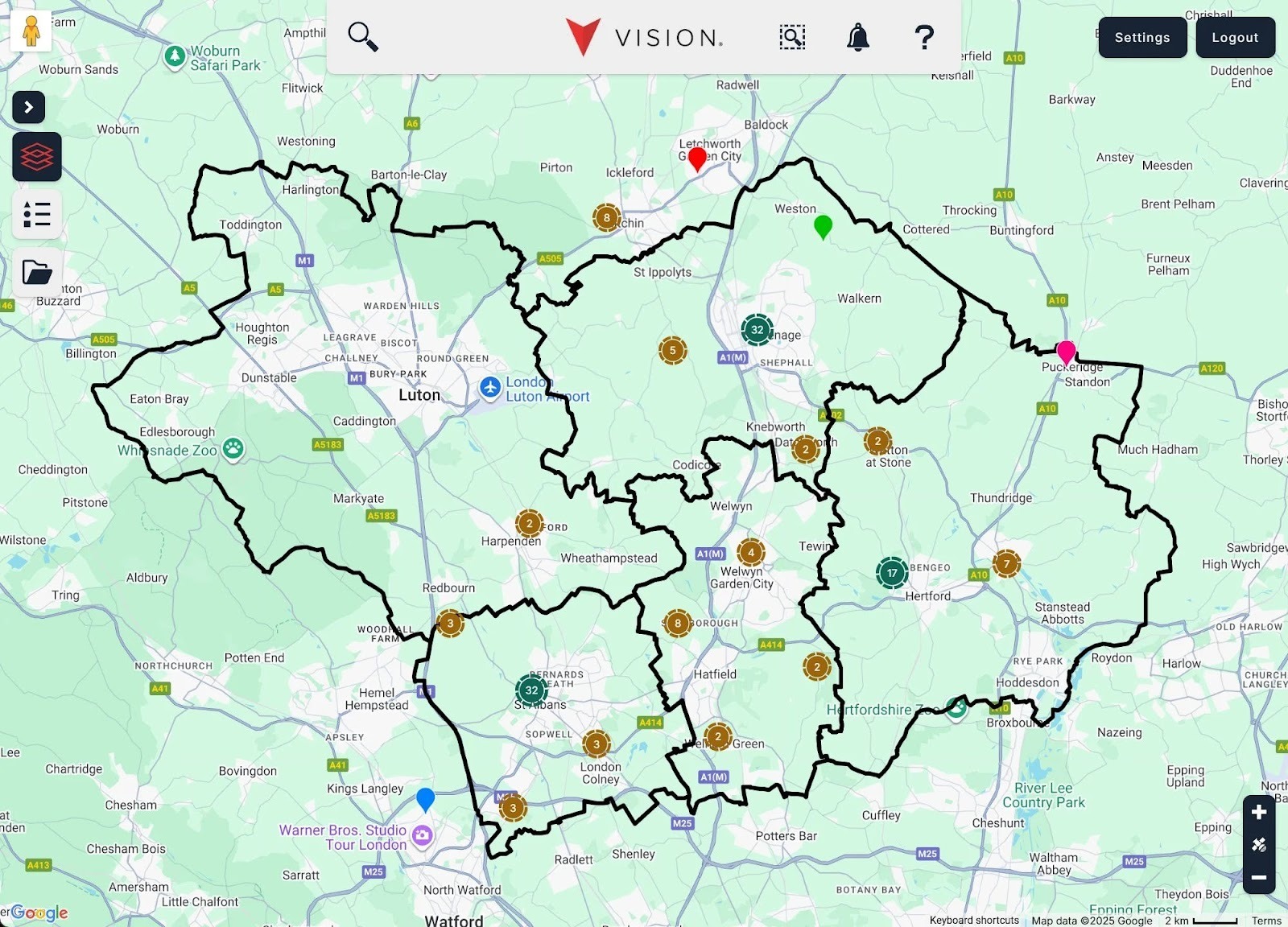
Example of customers and branches pinned within the Luton area on our Vision platform to see how well a territory is being covered and how far people are willing to travel.
At Atlas Mapping we believe geography is the invisible backbone of any business. Whether you’re launching a new store, expanding a franchise, planning field-team routes or mapping service areas, location matters and getting it right can transform your bottom line.
Our Vision Platform software allows you to see the revenue opportunity anywhere you want to grow by visually showing the value of your potential customers in specific geographic areas. Not only this, our software layers your own customer data, demographic and economic data to give you a clear, visual, data-backed view. As well as this we offer data add ons packs for certain industries such as UK school data, UK business data and so much more.
That means you can:
- Identify where your customers are clustered
- Spot underserved areas or regions with high growth potential
- Avoid cannibalising your own business when opening new branches
- Structure territories and coverage areas in a way that’s efficient and scalable
It’s more than mapping - it’s turning locations into insight.
Location Matters More Than You Think
Picking the right location for a business isn’t just a checkbox at the start-up stage. It’s a foundational, strategic decision that influences costs, customer reach, operational ease and long-term growth.
With the right data, a clear understanding of demand, and tools like Atlas Mapping’s vision software to guide you, you don’t have to rely on guesswork or gut feelings. Instead, you make decisions that stand up to scrutiny, support your brand, and adapt as your business evolves.
If you’re thinking about where to base your next endeavour whether a shop, branch, franchise outlet or service area, take the time to map your options. Location isn’t just a place. It’s a strategic advantage.
Ready To Plan Your Next Location For A Business With Confidence?
If you are ready to streamline the process of mapping new locations to optimise your business growth or even if you just want to find out a little bit more about how our software could help your business.
Get in touch today and our team is happy to help you take those all important next steps for your business.


.svg)