September 7, 2026
Giving a salesperson a bad boundary setup is a quick way to lose revenue. One rep gets a busy town center filled with potential clients. Another gets miles of open country with hardly any businesses around. It is unfair and it wastes time.
Good sales territory planning fixes this problem. It is about matching market opportunities with what your reps can actually handle. You need to make sure everyone on the team has a fair shot at hitting a target.
Whether you run a field sales team or manage franchise areas, here is how to build a detailed plan that works.
What is Sales Territory Planning and Why Does it Fail?
At its simplest, sales territory planning is how you divide accounts, leads, and regions between your sales reps. The main goal is to cover your market properly without burning out your team.
Most plans fail because managers rely on guesswork or basic Postal area splits. This causes big problems:
- Over-served areas: Too many reps pitch the same clients. This creates internal friction, annoys prospects, and lowers conversion rates.
- Under-served areas: High-value leads get ignored because the assigned rep has too many accounts or lives too far away.
- Rep burnout: Travel times eat up the working day. Reps spend four hours driving for a thirty-minute meeting.
When boundaries make no sense, reps lose motivation. Staff turnover goes up. You need a setup based on clear spatial facts instead of old spreadsheets.
1. Look at Your Customer Data
Do not draw lines on a map until you know where your customers actually are. You need to look at your sales history first and build a clear picture of account value.
Check your current customer base to see where revenue comes from:
- High-value accounts: Where are your top paying clients located right now? Look for geographical clusters.
- Business types: What types of companies buy from you most often? Track their locations, employee counts, and turnover. Or create a customer profile using a business data provider.
- Travel logs: How far are reps traveling to visit these accounts? Calculate the hidden cost of those trips.
Mapping this data shows you where real opportunity lives. You will spot white space on the map where high-potential leads exist but no rep is currently assigned.
2. Balance Workload and Opportunity
A small territory in a central city can have way more work than a huge rural area. Driving time matters just as much as account numbers. A rep sitting in traffic on the M25 is not selling.
You have to balance two main elements:
- Commercial Potential: The total addressable revenue from active accounts and new prospects in that specific boundary.
- Physical Workload: The practical time needed to service those accounts, including drive times, meeting prep, and admin work.
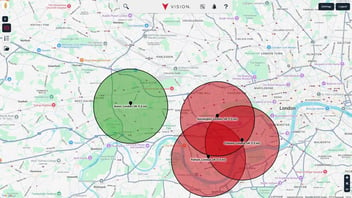
Using specialised location tools helps you calculate true drive-time zones instead of simple radius circles. At Atlas Mapping, we help businesses build balanced regions using demographic and drive-time datasets so reps get a fair workload.
Mastering Sales Territory Planning With Better Data
Relying on gut feeling to set regions usually leads to missed targets. Modern sales territory planning works best when you can see your data clearly on an interactive map.
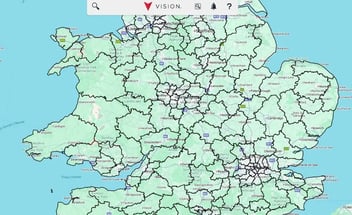
Software like Vision mapping software lets you drop your account locations onto a visual layout. You can test boundary changes before you make them official.
Mapping tools help you:
- Plot existing clients alongside fresh market datasets to see total coverage.
- Run "what-if" boundary changes to check how drive times and account counts shift.
- Balance regions automatically using population, business density, or affluence data.
When reps see the logic behind their patch, they accept changes much easier because the facts are right in front of them.
3. Match Reps to the Right Areas
Not every rep has the same skill set. A senior salesperson used to dealing with huge corporate accounts needs a different patch than a new starter handling smaller accounts.
When you assign areas, think about these factors:
- Experience level: Assign complex, high-value patches with long sales cycles to seasoned reps.
- Local knowledge: Put reps in regions where they already have established networks or local market insight.
- Travel capacity: Keep travel sensible so reps spend time selling instead of driving down highways.
If your team works in the field, organising their routes properly alongside their boundaries saves massive amounts of time. Grouping accounts by proximity reduces drive times and increases face-to-face meetings.
4. Review Your Setup Regularly
Your territory plan is never completely finished. Businesses move, reps change jobs, and markets shift over time. A setup that worked two years ago might be costing you sales today.
Check your map every few months and look for issues:
- Quota variance: Are some reps hitting targets easily while others in different regions struggle despite equal effort?
- Coverage gaps: Are there high-value postcodes where leads lie cold for weeks?
- Travel bloat: Have travel hours increased due to new client additions far outside the core patch?
Making small, sensible adjustments regularly stops you from having to tear up the whole map every year.
Getting Started With Your Plan
A simple, clear territory plan keeps your sales team focused on the right areas. When workload is fair and data is clear, your team can spend more time closing deals and less time worrying about their patches.
Are you ready to see how simple mapping your territories can actually be? You can get started with Vision mapping software for free to plot customer data, view local demographics, and start building better territory maps today. If you need hands-on help with a complex project, the team at Atlas Mapping is always ready to help make your territory planning more efficient.

Over 15 years of experience strategically advising businesses using geo-data and leading the Atlas Mapping team. His work spans international markets and businesses of all sizes.

.svg)